



When Does Insurance Make Sense in Blackjack?
Blackjack Insurance Bet is a separate wager offered when the dealer shows an Ace. It can look like protection for a good hand, but the decision is really about probability. The key question is simple: Is the dealer likely enough to have a 10-value card underneath to justify a 2:1 side bet?
Blackjack Insurance Bet Rules
Insurance appears at a very specific moment. The dealer’s exposed card is an Ace, creating the possibility that the hidden card is a 10, Jack, Queen, or King and completes a natural blackjack.
The insurance wager is separate from the original hand. In most blackjack games, it is limited to half of the initial bet and pays 2:1 when the dealer has blackjack.
Suppose the original wager is PHP 1,000. The maximum insurance bet would normally be PHP 500.
If the dealer has blackjack:
- The PHP 500 insurance wager wins PHP 1,000 in profit.
- The original PHP 1,000 hand is settled separately.
- The result of the main hand does not change the insurance payout.
If the dealer does not have blackjack, the PHP 500 insurance wager is lost immediately and play continues with the original hand.
That separation matters. Insurance does not strengthen a weak hand, rescue a strong one, or improve the cards already dealt. It is simply a side bet on whether the dealer’s hole card has a value of ten.
The Mathematics Behind Insurance
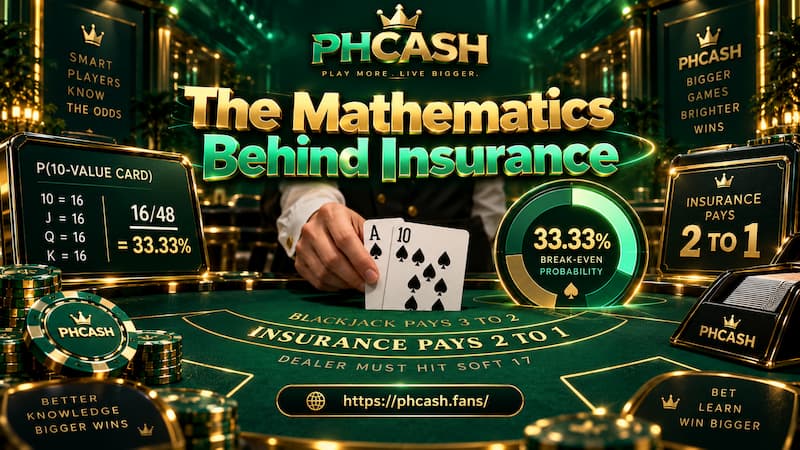
The 2:1 payout gives Blackjack Insurance Bet a clear break-even point.
The Mathematics Behind Insurance
Imagine making the same PHP 100 insurance wager three times. If you win once and lose twice:
- One win produces PHP 200 profit.
- Two losses cost PHP 200.
- The total result is zero.
That means insurance must win more than one-third of the time to become profitable.
The 33.33% Break-Even Point
The required probability is approximately 33.33%.
In a fresh six-deck shoe, there are 312 cards. After the dealer’s Ace is exposed, 311 cards remain unseen. Of those cards, 96 are 10-value cards: the tens, Jacks, Queens, and Kings.
The probability that the dealer’s hidden card completes blackjack is therefore roughly:
96 ÷ 311 = 30.87%
That falls below the 33.33% break-even level.
Expected Value in a Fresh Shoe
The expected value can also be written directly:
EV = Probability of winning × 2 − Probability of losing × 1
Using the six-deck example:
EV ≈ (30.87% × 2) − (69.13% × 1) = -7.4%
So, in a normal fresh-shoe situation, the Blackjack Insurance Bet carries a negative expectation of roughly 7.4% of the insurance stake.
A PHP 1,000 insurance wager does not mean someone will lose exactly PHP 74 on that hand. Expected value works over many repetitions. It means that making the same type of wager repeatedly under similar conditions would statistically cost about PHP 74 per PHP 1,000 wagered.
When Insurance Becomes Mathematically Reasonable
Insurance is not automatically a bad bet forever. The important detail is the composition of the cards still left in the shoe.
If enough low cards have already been dealt, the remaining cards can become unusually rich in tens, Jacks, Queens, and Kings. Once the probability of a 10-value hole card rises above 33.33%, insurance moves from negative expected value into positive expected value.
A Ten-Rich Shoe
Consider two very different situations.
In the first, the shoe still contains a normal mix of low and high cards. There is no reason to believe the dealer’s chance of blackjack is unusually high. Insurance remains unattractive.
In the second, many 2s, 3s, 4s, 5s, and 6s have already appeared while an unusually large number of 10-value cards remain. The dealer showing an Ace now carries a higher blackjack probability.
That is the type of situation where Blackjack Insurance Bet can make mathematical sense.
Notice what does not affect the calculation:
- Whether your hand is 12 or 20
- Whether you won the previous five hands
- Whether the original wager is PHP 200 or PHP 20,000
- Whether the dealer recently made several blackjacks
- Whether you feel a blackjack is “due”
Only the composition of the remaining cards changes the true probability.
Card Counting and Insurance
This is one reason insurance is closely associated with card counting.
Under the common Hi-Lo counting system, a strongly positive count suggests that more high cards remain relative to low cards. A frequently used insurance index is around a true count of +3.
At that point, the concentration of 10-value cards can become high enough for insurance to cross its break-even threshold.
That does not make +3 a universal number for every game. Different counting systems, deck numbers, penetration levels, and rule sets can use different indexes. The broader principle is more important: Insurance becomes rational only when card information changes the underlying probability.
A Strong Hand Does Not Make Insurance Better
The emotional temptation is strongest when the player is holding a hand that feels too good to lose.
Imagine betting PHP 5,000 and receiving a total of 20. The dealer turns over an Ace. Insurance of up to PHP 2,500 is offered.
Paying the extra PHP 2,500 can feel like protecting the PHP 5,000 already on the table. Mathematically, however, the player’s 20 does not make the dealer’s hole card more likely to be worth ten.
The Hedge Trap
This is where many players misread the wager.
A Blackjack Insurance Bet is not priced according to the strength of the player’s hand. It is priced at 2:1 regardless. The dealer’s hidden card is either a 10-value card or it is not.
The original bet can make insurance feel more important because more money is emotionally at risk. But increasing the insurance amount does not improve its expected value.
At PHCASH, the practical approach is to treat insurance as an additional decision rather than an automatic attachment to the original blackjack wager. A PHP 2,500 side bet is still PHP 2,500 of extra exposure, even when it feels like protection.
Insurance and Even Money
Even money creates another situation where the same mathematics can be hidden behind different wording.
Suppose the player has a natural blackjack while the dealer shows an Ace. Instead of waiting to see whether the dealer also has blackjack, the game may offer even money.
Accepting it usually means locking in a 1:1 win immediately.
Even Money Is Closely Related to Insurance
Assume the original wager is PHP 1,000.
A normal blackjack paying 3:2 would produce PHP 1,500 profit if the dealer does not also have blackjack. If both sides have blackjack, the hand normally pushes.
Taking even money guarantees PHP 1,000 profit instead.
That certainty can feel attractive, but mathematically it is essentially the same insurance decision in another form. The player is giving up part of the potential blackjack payout in exchange for protection against the dealer also holding blackjack.
The same 33.33% probability threshold is therefore relevant.
Without evidence that the remaining shoe is especially rich in 10-value cards, taking even money generally trades expected value for certainty.
Table Rules Still Need Attention
Blackjack tables are not identical, whether opened from PHCASH live casino section on desktop or through app phcash. Before making an insurance decision, check the rules attached to the game being played.
Important details include:
- Confirm the insurance payout. Standard insurance normally pays 2:1.
- Check the maximum stake. Insurance is commonly capped at half the original wager.
- Check the number of decks. Deck count affects the exact starting probability.
- Review the dealer procedure. Hole-card and peek rules can differ.
- Confirm the blackjack payout. A 3:2 table and a 6:5 table already have different economics before insurance is considered.
- Check whether even money is offered when holding blackjack against a dealer Ace.
These rules do not eliminate the basic insurance calculation, but they matter when judging the blackjack game as a whole.
The Practical Insurance Decision
For ordinary blackjack play without reliable information about the remaining shoe, declining insurance is usually the stronger mathematical choice.
The Practical Insurance Decision
The reason is not that insurance is “always bad.” The reason is more precise: Under normal card composition, the probability of the dealer having a 10-value hole card is below the 33.33% required by a 2:1 payout.
Insurance becomes defensible when that probability changes.
A disciplined decision can therefore be reduced to three steps:
- Ignore the strength of the original hand.
- Treat insurance as an independent side bet.
- Take it only when there is credible evidence that more than one-third of the relevant unseen cards are 10-value cards.
That distinction separates probability from instinct. A Blackjack Insurance Bet is not really about protecting a good hand. It is about deciding whether the dealer’s hidden card is being offered at favorable enough odds.
- Learn more: How the Don’t Pass Bet Works in Craps