



What Slot Ratings Can and Cannot Tell Players
Slot Machine Ratings can simplify slot comparison, but a single score rarely explains how a game behaves. Here, the goal is simple: Separate useful mathematical data from opinion, then show how RTP, volatility, hit frequency, maximum wins, and bet size can be read together.
Slot Machine Ratings Measure Different Things
A rating only becomes useful when you know what produced it.
An 8.7/10 review score may reflect graphics, bonus rounds, sound design, mobile performance, or how entertaining the reviewer found the game. A 96% RTP figure is completely different. It describes a mathematical setting built into the slot. A popularity ranking measures something else again: How often people choose that game.
Treating all three as interchangeable creates bad comparisons.
A slot can be visually excellent and receive strong reviews while having relatively high volatility. Another may look ordinary but offer a mathematical profile that suits someone who prefers more frequent, smaller wins.
Game Data and Editorial Scores
Useful slot information normally falls into two groups:
- Mathematical data: RTP, volatility, hit frequency, maximum payout, bet limits.
- Subjective ratings: Theme, graphics, sound, bonus design, interface, originality, and overall enjoyment.
Neither group is useless. They simply answer different questions.
A five-star score can tell you that people enjoyed the experience. It cannot tell you the probability of winning the next spin.
Reading RTP Without Misinterpreting It
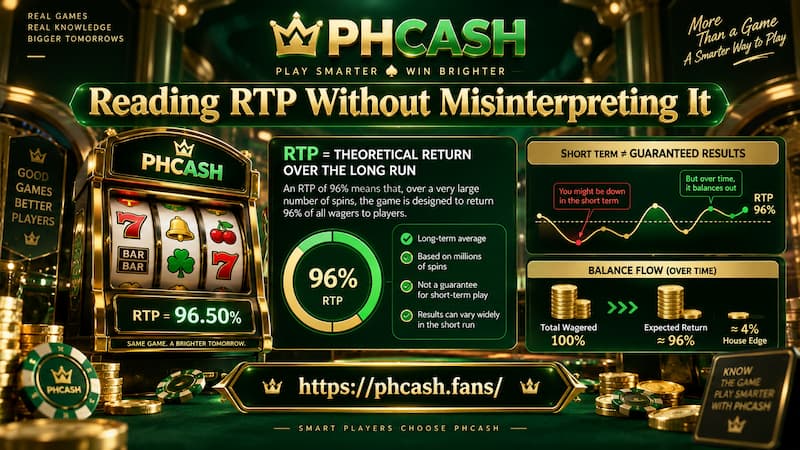
RTP, or Return to Player, is one of the most quoted numbers in Slot Machine Ratings. It is also one of the easiest to misunderstand.
A slot with 96% RTP does not mean that every ₱100 wager will return ₱96. RTP is a theoretical long-run percentage calculated across a very large number of plays.
Reading RTP Without Misinterpreting It
Imagine two short sessions:
- Player A wagers ₱2,000 and finishes with ₱2,600.
- Player B wagers the same amount and finishes with ₱900.
Both could be playing the exact same 96% RTP slot. Short-term results can move far away from the theoretical percentage because individual spins are random.
RTP describes the mathematics of the game over the long run. It does not forecast the balance you will have after tonight’s session.
That makes RTP useful for comparing game structures, but weak as a short-term prediction tool.
Small RTP Differences Need Context
A 96.2% game may appear automatically superior to one at 95.8%. Mathematically, the first has the higher theoretical return. In actual play, however, volatility and feature game design may create a much more noticeable difference than the 0.4 percentage-point gap.
This is where reading only one number starts to fail.
Volatility Changes the Feel of a Slot
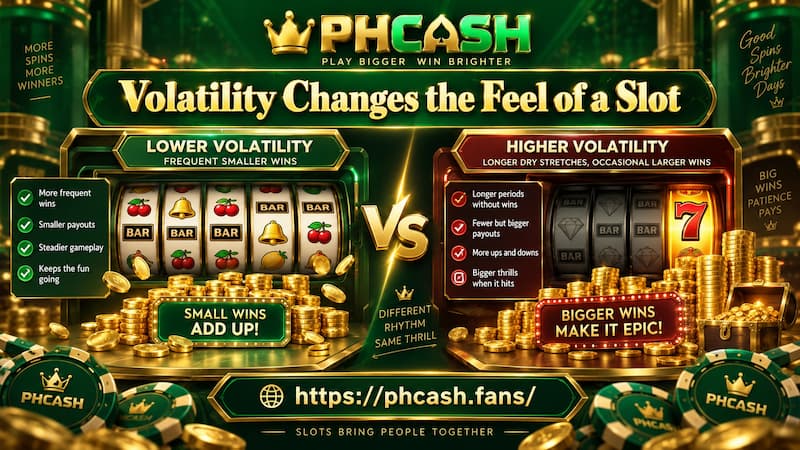
Volatility describes how payouts tend to be distributed.
Volatility Changes the Feel of a Slot
Lower-volatility games generally spread returns across more frequent, less concentrated payouts. Higher-volatility games can produce longer quiet periods while reserving more of their payout potential for larger results.
Neither is automatically better.
A player using ₱10 spins may enjoy watching the balance move steadily with regular small hits. Another may prefer a more dramatic game where bonus rounds or high-value combinations carry greater weight.
Volatility Is Not a Quality Grade
High volatility does not mean a slot is more advanced, more profitable, or more exciting for everyone. Low volatility does not mean a game is weak.
It is better to treat volatility as a description of rhythm.
The Same RTP Can Feel Completely Different
Consider two slots with 96% RTP.
Slot A has lower volatility and produces many modest wins. Slot B has high volatility and concentrates more of its theoretical return into less frequent outcomes.
Their RTP ratings look nearly identical on paper, yet playing them can feel nothing alike.
That is exactly why a useful Slot Machine Ratings comparison should keep RTP and volatility separate.
Hit Frequency Adds Another Layer
Hit frequency usually describes how often a spin produces a winning result.
Suppose one game has a 30% hit frequency. That does not mean 30% of spins generate a profit. Some winning combinations may return less than the original wager.
For example, a ₱20 spin could trigger a ₱10 payout. Technically, the spin registered a win. Financially, the balance still fell by ₱10.
This distinction matters because a high hit frequency can make a slot feel active without necessarily making it more rewarding over a short session.
Frequent Wins Can Still Be Small
When comparing two games, ask what the hit frequency is actually telling you.
A slot with frequent minor payouts may suit someone who prefers constant activity. Another with fewer winning spins may use larger bonus events to distribute more of its return.
The number alone does not rank one above the other.
Maximum Win Is a Ceiling, Not a Probability
Maximum payout figures are visually powerful. A slot advertising 5,000x, 10,000x, or 20,000x immediately attracts attention.
But the maximum win tells you only how large an outcome can theoretically become under the game’s rules. It does not explain how often that outcome occurs.
A 20,000x ceiling cannot answer:
- How frequently the bonus round appears.
- How difficult the required symbol combination is.
- How many spins may occur before a large result.
- How much of the theoretical return comes from smaller payouts.
- Whether the maximum requires a special feature or specific bet condition.
Pair Maximum Win With Volatility
A large maximum payout becomes more meaningful when read alongside volatility, feature mechanics, and hit frequency.
Without those numbers, the maximum win is mostly an upper boundary.
One Slot Title Can Have Different RTP Settings
A detail often missed in Slot Machine Ratings is that the same game title may exist in more than one RTP configuration.
Some game providers certify several mathematical versions of a slot. An operator can therefore offer a version with a different RTP from the figure listed in an old review or database.
That changes how ratings should be used.
If an article says a particular slot has 96% RTP, do not assume every available copy of that game necessarily uses that exact configuration.
Check the Game Version Being Played
Before relying on an external rating, check the information available inside the game itself.
Look for:
- RTP or theoretical return.
- Volatility information where provided.
- Paytable and winning combinations.
- Minimum and maximum bets.
- Bonus rules.
- Maximum payout conditions.
Provider data shown within the game is more relevant to the version currently being played than a rating copied from another source years earlier.
Using Slot Machine Ratings at PHCASH
When choosing a game at PHCASH, Slot Machine Ratings work best as a filtering tool rather than a final verdict. Start with the mathematical profile, then decide whether the mechanics and betting range fit the type of session you want.
A practical comparison could follow this order:
- Check the available RTP.
- Identify the volatility level.
- Look at hit frequency if the provider publishes it.
- Review the maximum payout separately.
- Understand the paylines, ways-to-win, cascading reels, or cluster mechanics.
- Check the PHP bet range before starting.
PHP Bet Size Changes the Practical Risk
Percentages can look abstract until real money enters the picture.
A high-volatility slot played at ₱10 per spin behaves mathematically the same way as it does at ₱100 per spin, but the effect on the balance is very different.
One hundred ₱10 spins represent ₱1,000 in total wagers before returns. The same number of spins at ₱100 represents ₱10,000.
The rating did not change. The financial exposure did.
That is why bet size deserves a place beside RTP and volatility when comparing games.
Comparing Two Slot Ratings Properly
Consider two fictional games.
Slot A
- RTP: 96.3%
- Volatility: High
- Hit frequency: Lower
- Maximum payout: 10,000x
Slot B
- RTP: 95.9%
- Volatility: Low
- Hit frequency: Higher
- Maximum payout: 1,500x
Slot A has the stronger RTP figure and much larger maximum win. Slot B may produce winning combinations more regularly and create a steadier session.
Which has the better rating?
There is no useful answer until the purpose of the comparison is defined.
If the goal is theoretical return, Slot A leads. If the goal is payout frequency, Slot B may fit better. If the question is which one will win on the next spin, neither rating can answer it.
Ratings Work Better as Filters Than Forecasts
This is the most practical way to use Slot Machine Ratings.
Use them to narrow hundreds of games into a smaller group with characteristics you prefer. Do not use them to decide that a machine is “ready to pay” because it has been quiet or because another player recently won.
Each rating describes part of the game. None can predict the next random outcome.